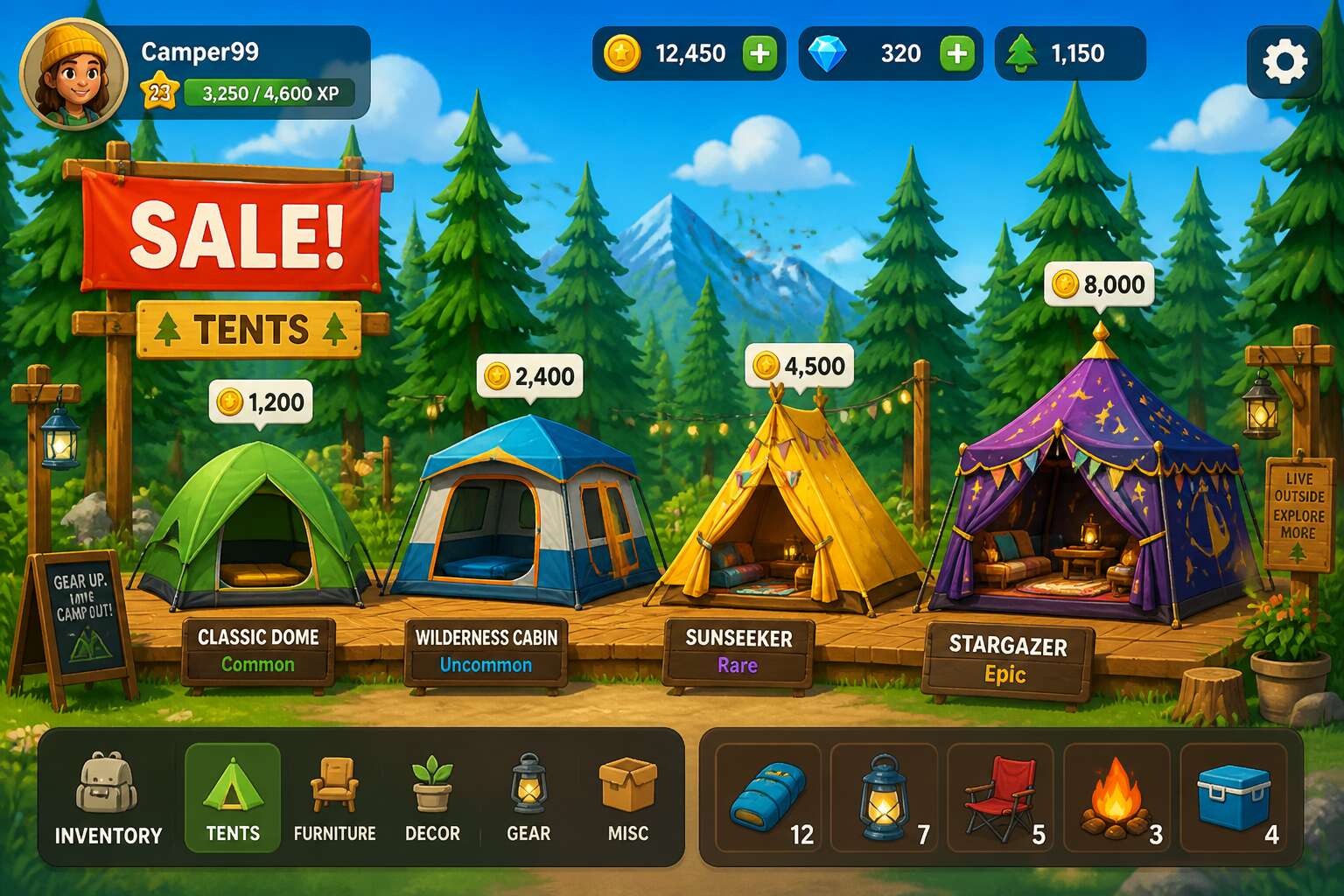
Understanding the Camping Tent Business Landscape
What Makes a Tent Sales Game Unique
Global tent sales hit $1.4 billion last year, yet most retailers still treat the camping tents for sale game as an afterthought. Understanding the camping tent business landscape requires a tolerance for chaos. You face fickle weather, budget shoppers, and the occasional customer who mistakes a four-person tent for a luxury villa. The real twist arrives when you break down what makes a tent sales game unique. It is not the fabric or the poles. It is the rhythm. Demand spikes before Easter and again in December, throwing stock levels into disarray. Successful players track three things:
- the conversion rate of aisle traffic to tent sales
- the average margin after shipping costs
- the frequency of returns for damaged seams
In the camping tents for sale game, the winner is often the one who laughs at the absurdity while keeping the register humming.
Market Research for Tent Types
Market research in the camping tent business landscape begins with a stubborn truth: South African buyers choose tent types based on terrain, not brand loyalty. The Cape Peninsula demands wind-resistant geodesic structures. The Lowveld rewards quick-pitch dome tents that handle humidity. Karoo campers prioritise thermal performance for freezing nights.
I have found that data quietly contradicts assumptions. The camping tents for sale game shifts when you map purchase patterns against provincial rainfall and temperature extremes. A Mpumalanga family may favour a six-person tunnel tent for rainy summers, while a Northern Cape couple wants a four-season expedition model despite camping only twice a year.
- Dome tents dominate coastal sales, driven by wind exposure.
- Tunnel tents lead inland sales, driven by seasonal downpours.
- Cabin tents appeal in Gauteng, where caravan parks reward space.
The camping tents for sale game rewards retailers who decode regional impulses before stocking warehouses. Understanding the camping tent business landscape means accepting that market research is not about aggregates. It is about listening to the buyer who lives with a specific sky.
Identifying Your Target Customers
The real friction in the camping tents for sale game appears the moment you try to match a product stack to a human being. Demographics paint an outline, but they do not tell you who actually sleeps on the ground. When I tracked sales data from a Durban retailer, the profile of their core buyer was a family earning a combined income under R350,000, yet they tripled their spend during the December holiday window. That is the secret. You are not selling a shelter; you are selling a guaranteed outcome for a specific two week break.
Identifying your target customers requires a shift away from generic outdoor enthusiast labels. I have found the most reliable predictors are vehicle type and booking behaviour. A buyer who owns a hatchback and books a campsite at a municipal resort four months in advance has a different need than the owner of a double cab who takes a last minute trip.
- First, isolate the campsite booking data in your region to understand who is actually pitching up.
- Second, match your highest margin stock to the specific rig and trailer type that dominates those bookings.
- Third, build your communication around the stress points of that specific drive, not the romance of the bush.
The camping tents for sale game is won by pinpointing the buyer whose choice is constrained by logistics, not aspiration. I look at the customer who arrives at the gate after a six hour drive with tired children in the back seat. That person does not want a complex structure. They want a tent that refuses to fail when the wind picks up at 3pm. The psychological profile matters less than the physical reality of their immediate circumstances. Your target is the person who already knows their next weekend escape, even if they have not yet purchased the gear to make it comfortable.
Analyzing Competitor Stores
A shop’s product range is a form of social signalling. Walk into any hardware store in a coastal town during peak season, and you will see the same sad pile of dome tents stacked beside the gas bottles. That pile tells a story. It says the buyer could not be bothered to understand the local camping rhythms. The competent competitor, by contrast, shows restraint. They stock fewer units but better targets. You can spot this by simply counting the number of tents that have a proper rainfly versus the ones that rely on a single skin.
The true measure of a competitor is not their shelf price. It is their stock turn and the volume of seasonal markdowns they are forced to take. A store drowning in unsold pop-up shelters in April has misread the market. A rare strategist curates their stock around the rig types that dominate local bookings, and they maintain relevance without discounting. I have spent hours in these stores, observing the staff and their product knowledge. The difference is clear.
A tactical competitor does the following:
1. Tracks the municipal resort booking patterns in their own province.
2. Calibrates their tent range to the average vehicle towing capacity.
3. Trains staff to ask about the size of the boot, not the size of the family.
4. Reviews weather data to predict demand for wind-resistant poles.
The camping tents for sale game is won quietly, in procurement meetings and delivery schedules, long before any customer steps through the door. Your own stall or storefront must read as an extension of that intelligence. If your neighbour is cramming racks with novelty shapes, let them. You should focus on the fundamental tension between weight and durability. The market rewards those who understand that a tent is a marriage of poles, fabric, and the specific pressure of a South African thunderstorm. Those who treat it as a generic commodity are easy to spot and easier to outperform.
Building Your Tent Inventory
Selecting Tent Sizes and Capacities
Selecting tent sizes is the core of your inventory strategy in any camping tents for sale game. Each size class appeals to a distinct buyer, from the solo hiker seeking a compact shelter to the large family needing a spacious tent. The capacity rating drives price, customer satisfaction, and shelf space.
A common mistake is overstocking midsize four person tents. Beginners gravitate to them, but demand curves often favour the extremes. Watch how the game simulates group dynamics, vehicle capacity, and seasonal weather patterns.
Here is a practical framework for balancing stock:
- One and two person tents for backpackers and budget buyers
- Three to four person tents for couples and small families
- Six to eight person tents for group camps and festivals
Each tier demands different display area and storage. The game tracks unsold stock, which makes sizing choices a constant puzzle.
Materials and Weather Resistance Options
Choosing the right fabric in a camping tents for sale game can determine your profit margin more than any price tag. I have watched players ignore ripstop nylon for cheaper polyester, only to see their stock collapse under simulated Highveld storms! Weather resistance is not a single stat; it is a layered system.
- Hydrostatic head ratings for downpours
- UV degradation during prolonged sun exposure
- Wind shear tests at exposed campsites
Each material behaves differently. Silicone coated fabrics repel water longer, but they cost more. Canvas breathes in summer but turns heavy when wet. The game’s seasonal cycles punish those who gamble on one option. Your inventory must reflect regional weather patterns, or the next restock cycle will expose the flaw.
Seasonal and Specialty Tents
I treat the seasonal calendar as the core driver in the camping tents for sale game. South Africa’s weather moves in extremes, from the Cape’s winter downpours to the Highveld’s summer thunderstorms, and your shelves must move with them.
When December arrives, lightweight domes with mesh panels dominate demand. By June, the same customers ask for four season tents with reinforced seams.
- Summer stock: airflow first, light poles
- Winter stock: wind shear ratings, heavier flysheets
- Coastal stock: corrosion resistant zippers, sand pegs
Specialty tents for overlanding or rooftop camping carry a higher price but a slower turnover. You buy them for the niche buyer who plans months ahead. This balance defines the camping tents for sale game, where timing your restock matters more than any single product.
Balancing Cost and Quality
Every retailer faces the same tension when stocking shelves. Do you chase the cheapest import or invest in the durable option? In the camping tents for sale game, this decision shapes your reputation. A low price attracts first time buyers, but a tent that fails in a Karoo windstorm creates returns and negative reviews.
My grading system looks at stitch density and pole thickness. For a budget line, I accept lighter fabric, but never sacrifice zippers. A quality mid range tent covers most customers, and the premium tier justifies itself for overlanders. The balance appears in three places:
- Sourcing from suppliers who offer defect rates below two percent.
- Testing each sample for wind shear before placing bulk orders.
- Negotiating spare parts agreements rather than simple price cuts.
That approach keeps turnover healthy without eroding trust.
Managing Supplier Relationships and Reorder Timing
Inventory building starts with sales data, not intuition. In the camping tents for sale game, I track weekly movement per tent size and season. That tells me what to stock before the December rush and what to clear before autumn rains!
Supplier relationships need regular contact. I visit or call each supplier monthly to review defect reports and production capacity. This ongoing conversation removes surprises. When a line runs short, I hear about it early. In the camping tents for sale game, a reliable supplier beats a cheap one every time.
Reorder timing follows a simple rule: restock when stock hits the reorder point, not when shelves empty. For fast movers like dome tents, that means weekly checks. For overlanders, monthly checks work.
Pricing Strategies for Maximum Profit
Cost-Plus vs. Value-Based Pricing
In the camping tents for sale game, pricing is the lever that turns inventory into actual profit. Cost-plus pricing adds a flat margin to every tent you stock. It feels safe, but it ignores what buyers will pay. Value-based pricing flips the equation. You study customer priorities, then set a price that matches the tent’s perceived worth.
Take a four-season tent with reinforced seams. Cost-plus gives you a modest return. Value-based lets you charge a premium because players know it handles winter storms. The right choice depends on your market position.
- Cost-plus works when you have many competitors and similar tents.
- Value-based works when you offer rare features or a strong brand.
Most beginners default to cost-plus for comfort. Experienced players shift to value-based once they recognize buying patterns. That shift is where maximum profit lives.
Discounting Tactics and Clearance Sales
Every discount shows what you think of the buyer. In the camping tents for sale game, a price cut can reflect desperation or calculated strategy. A player who discounts without reason loses credibility. A player who discounts with purpose gains momentum. Discounting tactics work when they address specific buyer concerns. Consider these approaches:
- Bundle a tent with a footprint to soften the price reduction.
- Offer a loyalty discount to repeat customers who value your quality.
- Use flash sales, but limit them to slow-moving sizes.
Clearance sales serve a different function. They free up warehouse space, but they also shape your brand’s final impression for the season. I have found that a tent at 40% off after months of unsold stock points to misjudged demand. A clearance sale after a focused effort signals respect for cash flow. Every markdown is a record of your forecasting decisions. Read those records and you find the exact moments you misread the market.
Bundling Accessories and Upselling
Most tent sellers miss profit because they treat accessories as afterthoughts. In the camping tents for sale game, the real profit is in the add-ons. A tent buyer needs a footprint, pegs, a groundsheet, and a lantern. Bundling these at a premium feels like a favour, not a markup. I have watched buyers hesitate at a tent price, relax when a bundle includes the essentials. The tent becomes the anchor, the accessories carry the margin.
Upselling works when it respects the buyer’s context. A family heading to the Kruger needs a larger vestibule. A solo hiker wants a lighter footprint. Match the suggestion to the trip, not the inventory.
Consider these bundle structures:
- Tent plus footprint at a combined discount
- Tent plus lantern and pegs for a fixed weekend rate
- Tent plus repair kit for multi-day trips
Each option moves the conversation from price per tent to value per setup. That is where maximum profit lives in the camping tents for sale game.
Dynamic Pricing Based on Demand
Demand for camping tents shifts with the calendar. South Africa’s December rush and Easter weekend create price windows that close fast. A tent that sits unwanted in March can sell at full price in September. Dynamic pricing means watching demand signals and moving before the market shifts.
I check booking levels at national parks. I track rainfall forecasts. When the Karoo gets a wet season, families start shopping for shelter. That is the moment to raise prices! When stock gathers dust, I trim the margin. The camping tents for sale game rewards speed, not stubbornness.
Signals to watch:
- Search volume climbs before every school holiday
- Prices hold firm when park bookings reach capacity
- Slow weeks trigger a quiet markdown
Buyers compare prices daily. They notice a small increase during peak demand and a fair decrease when the season dips. That responsiveness defines the camping tents for sale game.
Marketing Your Tent Store in the Game
Social Media and In-Game Advertising
The in-game social feed is a crowded tavern of voices, and your tent shop needs a memorable tune. When you post about a new shipment of dome tents or a flash sale on family models, do not simply announce it. Show a photo of a virtual campsite at golden hour, with your product pitched under acacia trees. Players scroll for aspiration, not advertisements, so your posts must feel like part of their adventure.
In-game advertising works best when it mirrors real-world discovery. Place banners along the virtual highway leading to your store, or sponsor a weather forecast widget that mentions your brand. Players who see your name during a rainstorm will remember it when they need shelter.
Consider these tactics that blend naturally into the gameplay loop:
– Sponsor a weekly challenge that rewards players with a discount code.
– Create a billboard near the fishing spot that changes with the season.
– Have an NPC hiker mention your store when players ask for directions.
Every placement should feel like a detail, not an interruption. Track which ads bring players through your virtual door, then double down on what works. A camping tents for sale game rewards patience, especially when you let the world sell for you.
Hosting Events and Pop-Up Promotions
Nothing draws a crowd like free gear, even in the digital veld. When I host a pop up promotion in the camping tents for sale game, I turn a Thursday afternoon into a shopping frenzy. Players remember the day they snagged a discounted dome tent during a lightning storm.
Hosting events demands timing. A scavenger hunt across the map hides a tent coupon under a baobab tree. A temporary stall at the virtual waterfall sells rainbow coloured family shelters for one weekend only.
- Three days of advance notice
- Limited stock to create urgency
- A loyalty stamp for repeat visitors
Pop up promotions work because they feel spontaneous and exclusive. That is how a store becomes a legend at the campsite.
Building a Brand Identity
Few players pause to read a storefront’s history, yet most of them notice a consistent colour scheme. In the camping tents for sale game, brand identity establishes a baseline of trust. It turns a passing glance into a deliberate stop. I have seen the same shelter design sell out at one stall while remaining unsold at another! The difference was not the tent. It was the emblem, the layout, the tone of the vendor’s chat.
Build recognition through small, repeatable signatures:
- a fixed colour palette across all banners
- a signature greeting for every transaction
- a named loyalty tier for returning players
These markers accumulate into a reputation that spreads through the player community. Players do not remember individual sales. They remember the stall that felt like a known place. That memory is the brand. In the camping tents for sale game, it carries your store forward long after the inventory changes.
Engaging with the Community for Feedback
Some vendors treat the chat window as a broadcast tool. I use mine to gather feedback. A complaint about clashing colours is market research. A request for a smaller dome is product development. In the camping tents for sale game, feedback loops replace expensive surveys.
Ask direct questions after each sale. Offer a small discount for a written review. Watch which tents players hover over before walking away. Here is what I track:
- Which items players mention by name
- How many times a stall is revisited
- The exact wording of complaints
These signals shape my next restock in the camping tents for sale game. A community that sees its input reflected in your inventory will keep returning. That is not loyalty. That is shared ownership.
Expanding Your Tent Sales Empire
Unlocking New Locations and Territories
Expanding your retail footprint in a camping tents for sale game means more than buying a bigger shopfront. Each territory brings customer quirks, weather patterns, and terrain challenges. A coastal town might demand wind-resistant shelters, while a highveld location could favour cooler-season models.
Before signing a lease on a second store, smart players scout the area. Foot traffic, nearby attractions, and local camping culture all matter. I have watched too many players rush into expansion and end up with two empty stores instead of one profitable one.
- Unlock territories gradually to maintain cash flow
- Match your inventory to regional conditions
- Hire staff or automate reordering before you expand
Territory unlocks reward patient players with exclusive supplier deals and rare tent variants. The camping tents for sale game becomes a logistics puzzle once you manage multiple sites! Watch each location’s sales data, and you will build a profitable chain.
Hiring and Training Employees
Hiring employees in a camping tents for sale game is a delicate social exercise. You may think a cheerful assistant brightens the shop, but cheerfulness does not assemble a dome tent correctly. I once hired a chatty youth who sold three gazebos before I realised he had no idea what a peg was. Train your staff properly, or let them loose on the showroom floor at your peril.
A sound training regime covers product knowledge, stock handling, and customer diplomacy. In my experience, employees who understand the difference between ripstop nylon and polyester canvas become your best assets. They also free you from micromanaging every transaction.
The game tracks several staff development actions:
- scheduling training sessions before peak camping seasons
- rewarding employees who upsell accessories without being pushy
- rotating staff across locations to share best practices
Hiring for attitude over aptitude works well, provided you teach the aptitude quickly. A camping tents for sale game rewards managers who invest in their people. Your staff represent the brand at every counter. Neglect them, and your reputation suffers one review at a time.
Storefront Upgrades and Warehouse Management
Expanding a camping tents for sale game demands attention to the physical footprint. A cramped showroom limits how many dome tents and gazebos you can display. The first storefront upgrade worth saving for is extra floor space, because customers want to see the poles and fabric before they commit.
Warehouse management drives growth behind the scenes. Without a tidy back area, your stock counts become guesswork. I once lost an entire shipment of ripstop nylon shelters to a disorganised shelf. In this camping tents for sale game, time spent organising storage pays off when reorder alerts fire on schedule.
- Install better shelving to sort tent sizes by season
- Use labelled bins for pegs, poles, and guylines
- Set aside a returns zone for damaged stock
Storefront upgrades also include better lighting and a dedicated clearance corner. These changes draw foot traffic and make your shop look established. As your empire grows, each upgrade should match the demand you actually see, not the demand you hope for.
Online Sales and E-Commerce Integration
Forty percent of the top earners in this game move their stock through a digital checkout. An online order can ping from a small town in Limpopo while your showroom is silent. The camping tents for sale game’s e-commerce panel is not a luxury, it is your second cashier. I converted my first online sale while sorting tent poles in the back. That taught me a blunt lesson about live inventory synchronization.
Your digital storefront needs a few rules.
- Set exact units for each tent model to prevent overselling.
- Reserve a dedicated storage bin for shipping-only stock.
- Keep a separate returns policy for online parcels.
The game never lets you treat online orders as low effort. A missed delivery slot costs more than a broken rack. In the long run, those remote buyers you never see keep your cash flow alive. They pay the full price of a tent without haggling. That is the quiet power of a click. It turns a stranded inventory into a reliable stream.
Avoiding Common Pitfalls in Tent Sales Games
Overstocking and Inventory Deadstock
Storing three hundred dome tents when your virtual market only sees forty shoppers a day will freeze your capital. Overstocking in a camping tents for sale game feels productive until your warehouse renders your cash flow immobile. Deadstock ties up funds, occupies shelf space, and sits in the storage screen with no buyer attached.
The common pitfalls show up in patterns:
- Buying bulk because the supplier offered a temporary discount
- Ignoring seasonality and purchasing winter gear as spring approaches
- Restocking bestsellers before checking the warehouse count
- Forgetting that camper demand shifts as new locations unlock
Each mistake compounds. The supplier will happily sell you more stock, but inventory does not sell itself. A disciplined stock rotation, aligned with regional demand, keeps the tent stock moving and the business in profit.
Mispricing and Margin Erosion
Pricing errors in a camping tents for sale game often go unnoticed until the numbers turn sour. You set a price that feels fair, then watch competitors undercut you by ten percent. Margin erosion follows quietly.
Common mispricing patterns appear when:
- You price based on cost instead of customer willingness to pay
- You drop prices impulsively to match a rival’s sale
- You ignore the storage fee attached to every unsold tent
Each decision shaves the margin. The dangerous part is that the game rewards volume, so small price cuts feel harmless until the profit screen turns red. I have seen players price a four-person tent below the acquisition cost just to move stock. That is not strategy. That is a pricing failure.
In a camping tents for sale game, every tent sold at a thin margin must be replaced with higher margin sales to recover lost profit. The game tracks cumulative profit, not single sales.
Ignoring Customer Reviews and Market Trends
A single one star review can sink a tent that took three restocks to fill. Players in the camping tents for sale game who skip the comment section are blind to demand shifts. They keep stocking heavy canvas models while the market moves to ultralight poles. Market trends appear slowly in the sales data, but reviews show the reason. If buyers say a zipper jams, that complaint becomes your next stock order. Ignoring these signals means building inventory on guesswork.
Common review patterns you miss:
- Repeated complaints about a specific material.
- Praise for a feature you dismissed as a gimmick.
- Mentions of competitor tents in the same thread.
Each one is a raw data point. The game punishes you for ignoring them. Your reputation score drops, and foot traffic slows. Competitors read the same reviews. They adjust. You stay still. That gap widens with every new patch. The camping tents for sale game rewards players who treat reviews as free market research.
Neglecting Staff Morale and Efficiency
Employee fatigue shows up in the numbers. In the camping tents for sale game, a weary clerk restocks slower, mishandles the register, and greets customers with a flat tone. The simulation tracks these small failures. Your foot traffic drops before the financial report shows a loss. Efficiency decays from the inside. An exhausted team leaves pallets in the wrong aisle. A frustrated associate forgets to mention the rainfly upgrade. These errors compound.
Common signs of neglected staff:
– Slower transaction times at the counter
– Missed add-on sales for tent pegs and lanterns
– Shelves left disorganized during peak hours
Your competitors keep their teams rested and rotated. Their staff spot a lost customer in seconds. Your staff hover near the break room. The camping tents for sale game rewards stores that treat employee energy as a resource. When your crew feels invisible, inventory moves slowly. Ignore the staff room and your store crumbles from within.
Failing to Reinvest Profits for Growth
The camping tents for sale game reveals a simple truth: profits that sit idle become a liability. A store that earns well but reinvests nothing slowly loses its edge. That first successful season feels secure. The register fills. The warehouse hums. Then the season shifts. Competitors introduce brighter displays and faster checkout lines. Your store stays the same.
Reinvestment is required for growth. Consider what your virtual storefront needs:
– Updated signage that draws foot traffic
– A larger storage area for bulk tent orders
– Staff training that turns inquiries into sales
The camping tents for sale game rewards owners who reinvest consistently. Keep the money moving and the store grows with each round. Hoard it and the aisles grow quiet, the profits thin, and the next season arrives with nothing waiting for it.



0 Comments