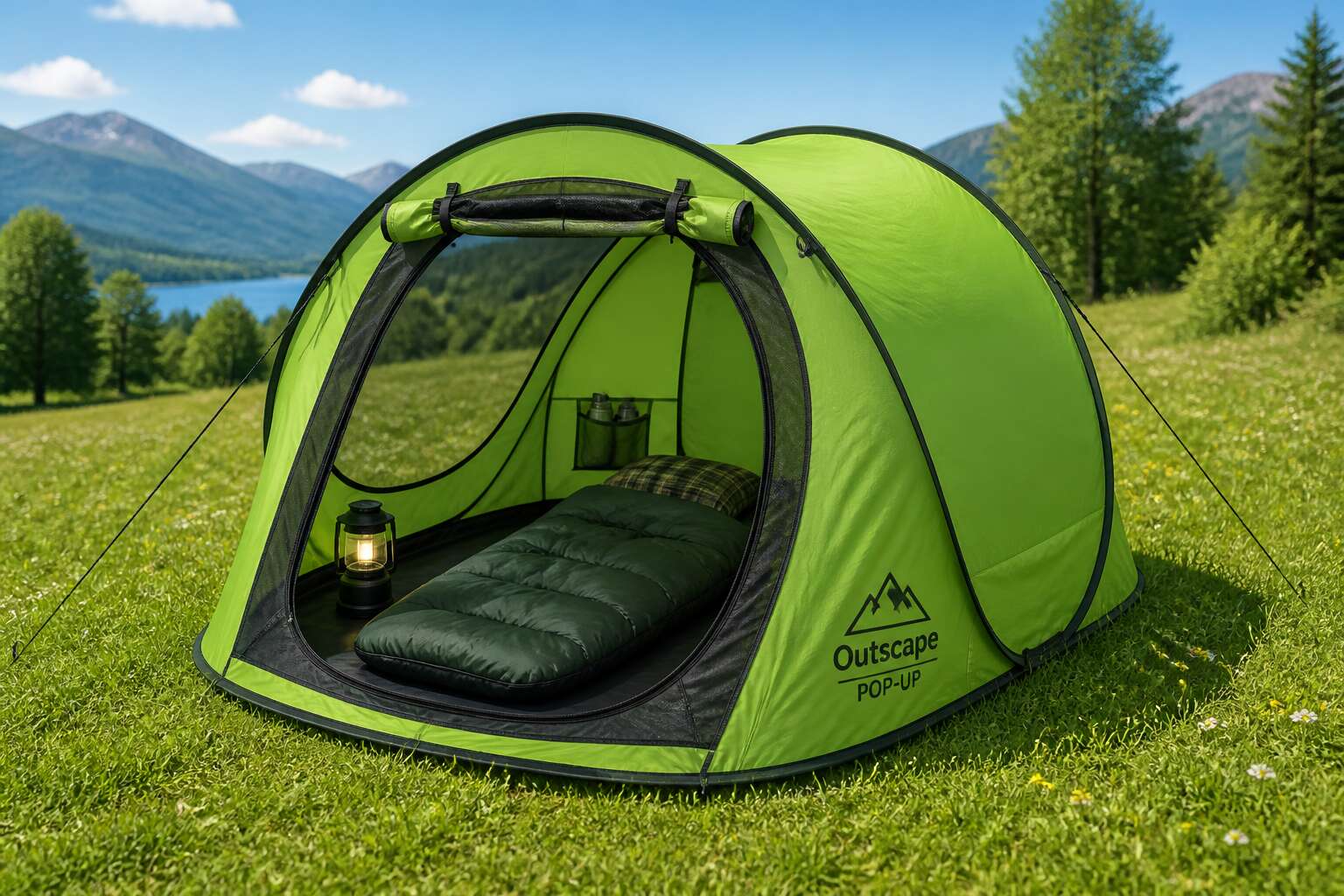
Decoding the Pop Up Tent Phenomenon
What Makes a Tent ‘Pop Up’?
Stand under a South African sun for ten minutes, wrestling a conventional tent, and you will understand the allure of camping tents pop up. These shelters rely on a pre-bent fibreglass or steel frame, sewn into the fabric. The whole contraption is twisted into a flat disc, then released. That release, a sudden snap of stored tension, is the “pop”.
The engineering is deceptively simple. A central hub holds the poles in place. When you take off the carry strap, the poles spring outward, dragging the canopy into shape. No sleeves to thread, no pegs to line up.
The catch? Packing one back down requires a certain technique, a twist-and-fold choreography that has humbled many a seasoned camper.
The Mechanics of Instant Frame Tents
Instant frame tents account for nearly a third of casual camping shelters sold in South Africa. The design shifts the load from setup time to packed volume. These camping tents pop up rely on a hinged scissor system with a sliding collar. Once raised, the geometry holds rigid without guy ropes.
A typical structure uses:
- Aluminum poles
- Spring-loaded hubs
- Seam-sealed rainflies
The trade-off appears in boot space. Instant frames take up more room than their pop-up counterparts. Yet the internal footprint often outweighs that bulk. For Karoo weekenders, the convenience justifies the extra volume.
Comparing Pop Up Tents to Traditional Models
At first light, the traditionalist still wrestles with canvas and cordage. The camping tents pop up stand ready nearby, frames stretched against the Karoo wind. One design asks for patience. The other offers immediacy. That contrast shapes the modern campsite.
The traditional tent rewards familiarity. You know its quirks, its creaks, the way it settles after rain. The pop up tent offers a different bargain. Speed in exchange for bulk. The packed volume sits heavier in the boot, but the time saved on a long drive is substantial.
Consider the practical differences:
- Traditional tents demand learned skill in pole placement and tension
- Camping tents pop up respond to a single motion, repeated twice for packdown
- Traditional frames tolerate heavy winds once fully guyed
- Pop up frames pack flat behind a bakkie seat
The choice is not about quality. Both keep the rain out. It is about what a camper values. The ritual or the release!
Top Reasons to Choose Pop Up Tents for Camping
Unmatched Speed and Convenience
Arriving at a packed campsite in the Cape after sunset is a common problem. Camping tents pop up solve it with one motion. You lift the folded disc from the boot, give it a firm upward shake, and the frame locks into place. No poles to sort. No sleeves to slide. Within minutes, you can toss in your sleeping bag and turn your attention to the fire.
- You avoid fumbling through setup in darkness.
- You claim a level patch of ground before others arrive.
- You reduce the time spent sweating under the midday sun.
For weekend travellers, that extra time converts directly into rest or adventure. The convenience extends to packing up. The same one-motion fold lets you break camp in seconds and hit the road before traffic builds. Camping tents pop up turn a chore into a simple, repeatable process.
Lightweight Portability for Travelers
Space in the boot of a bakkie runs out fast! Traditional tents bring a bundle of metal poles and fabric that shifts with every turn. Camping tents pop up collapse into a flat disc that slides behind the back seat or under a cargo net. The package weighs a fraction of a conventional dome tent. That matters when you haul firewood, a cooler box, and two kids along the N2.
The weight difference is tangible. A standard family tent with poles can reach eight kilograms. A pop up unit often sits at half that.
- A 70-centimetre folded diameter fits inside a daypack.
- No separate pole bag means fewer items to lose.
For hikers in the Cederberg, every kilogram counts. For fly-fishers crossing a river, the disc straps cleanly onto a backpack. This portability changes the calculus of spontaneity. You take the tent because taking it costs nothing. Camping tents pop up earn their place in any loadout by giving you freedom.
Durability in Unexpected Weather
On the Cape Peninsula, weather changes in minutes. Camping tents pop up handle this better than their rigid framed counterparts. The flexible fibreglass ribs absorb wind gusts that would snap a static frame. The fabric stays taut because tension dwells in the structure itself.
During the summer thunderstorm season in Mpumalanga, sudden downpours arrive without warning. Three construction details make the difference:
- Heat sealed seams prevent leaks without stitching
- Flexible frames bend with gusts instead of breaking
- Flysheets shed water while maintaining airflow
A friend watched his conventional tent fold during a Boknes squall. His neighbour’s pop up unit flexed and shed the rain. The dome shape deflects wind while the groundsheet stays anchored. Coastal salt air does little damage to the aluminium hubs. Camping tents pop up survive season after season along the Garden Route.
Versatility Across Camping Styles
A single tent rarely suits both a solo hiker and a family of five, yet camping tents pop up manage this balancing act with surprising ease. The design does not lock you into one mode of travel. One weekend you are moving quietly through the Cederberg with a light pack. The next you are part of a convoy of bakkies at a festive campsite near the Berg River, surrounded by the sounds of a proper South African kuier.
The same shelter fits these different styles:
- A quick overnight stop for a long distance cyclist
- A roomy base for overlanders using a rooftop tent
- A safe sleeping area for children while adults sit around the fire
The internal volume comes from the continuous flexing ribs and the central hub. This geometry gives you headroom that traditional dome tents often lack. You can sit upright, sort your gear, or play cards when the weather closes in. On uneven ground, the forgiving frame follows the contours without straining the fabric. That matters on the rocky banks of the Orange River or a forest floor covered in pine needles.
How to Select the Perfect Pop Up Tent
Assessing Capacity and Space Requirements
Most 4-person camping tents pop up with just enough floor space for four sleeping bags. Not one bag more. Camping tents pop up in seconds, but assessing capacity takes longer. In South Africa, where summer thunderstorms arrive without warning, that extra 30 centimetres of width matters. Measure the base, not the label.
The label counts bodies. Real life counts backpacks, boots, and a restless sleeping partner. Look for tents with vertical walls and a high peak. These features turn a 2.4 metre square into usable space. A dome profile cuts into headroom, so your elbows crowd the walls when you dress.
Comfort usually demands one extra person on the rating. Weight savings demand one fewer. Choose accordingly.
Seasonality Ratings and Weather Readiness
Seasonality ratings on camping tents pop up like a weather forecast from a gambling addict. A three season rating means the tent tolerates spring, summer, and autumn. It does not mean it will laugh at a Karoo hailstorm. Four season tents use heavier poles and stronger fabric, but they also turn your backpack into a chiropractor’s invoice.
South African summers throw lightning, wind, and sudden cloudbursts in the same afternoon. A 3 season pop up tent keeps you dry in a drizzle. It will not keep you dry when the Vaal Dam decides to relocate into your sleeping bag. Check the hydrostatic head rating. Anything below 1500 millimetres belongs at a picnic, not a campsite.
- Three season: fine for most South African weekends
- Four season: overkill unless you camp in the Drakensberg in July
- Convertible: useful, but heavier
Wind ratings matter too. Most camping tents pop up with a flimsy pole system that folds in a stiff breeze. Look for welded joints and storm straps. The label promises a lot; the sky delivers the verdict.
Material Quality and Fabric Denier
Fabric denier is the first number to interrogate. Higher denier means thicker weave, but it also means more weight. For camping tents pop up, 150D polyester is a sensible option. It withstands bushveld thorn scratches without adding too much pack weight. Ripstop nylon, with its crosshatched reinforcement, stops small tears from becoming weekend endings. A silicone coating beats polyurethane for long term water resistance. It does not degrade under UV light the way cheaper finishes do. Check the seams. Taped seams are non negotiable. A tent with untaped seams will leak at the needle holes.
- Look for a minimum of 150D on the flysheet
- Choose ripstop weave for tear resistance
- Prefer silicone coated fabric over PU
When comparing camping tents pop up, that selection process takes five minutes. The payoff is a shelter that survives a Kalahari gust without splitting at the edges.
Budget vs. Premium Pop Up Options
Choosing between budget and premium camping tents pop up comes down to how many seasons you intend to use them. A budget shelter may cost less than a night in a game lodge, but its poles and zippers often fail by the third outing. Premium options offer anodised aluminium struts and double stitched seams that survive years of Richtersveld wind.
That price gap translates into concrete realities! For the occasional weekend, a budget tent suffices. For monthly trips, the premium path saves money over time.
- Budget: lighter on the wallet, heavier on repairs
- Premium: higher upfront cost, lower lifetime cost
I have seen both fail. The key is matching the tent to your frequency, not your fantasies.
Mastering Pop Up Tent Setup and Breakdown
Step-By-Step Erecting Guide
You have wrestled with your camping tents pop up before, so you know the drill. The secret to erecting one is letting the spring frame do the work. Toss it onto level ground, keep your face clear, and release the straps. That is step one.
Secure the base by staking opposite corners first. This prevents a parallelogram of doom. Then adjust the flysheet for airflow. Breakdown demands patience. Pull the central hub upward, then fold the tent into thirds without forcing it.
- Find a flat, debris free patch.
- Release the compression straps and let the tent self erect.
- Peg the windward corners first.
- To pack, push the roof down and twist the frame into a figure eight.
Practise this sequence three times at home. Your camping tents pop up will thank you by not launching into a bush on your next trip.
Safe Folding and Collapsing Techniques
Most campers handle the tent’s sudden bloom, but the collapse is where tempers fray. Camping tents pop up demand respect for their spring mechanisms, especially when folding them into a carry bag. The frame stores energy, and releasing it carelessly sends metal poles snapping into awkward angles.
On a recent trip to the Cederberg, I watched a novice fight a stubborn hub for five minutes. He pulled against the fold, not with it. The trick is to let the central hub rise while you guide the side panels inward. Use your palm, not your fingers, to press the roof down. Then twist the frame into a figure eight and let the poles settle. Work slowly and the canvas follows without protest. Safe collapsing depends on this gentle persuasion.
- Never force the joints past their natural hinge.
- Kneel close to the tent to maintain control.
- Hold the folded bundle at chest height when bagging.
Most camping tents pop up suffer damage from impatient breakdowns, not weather. Master the fold and your tent will serve for seasons.
Troubleshooting Stuck Hinges and Poles
Nothing tests your patience like a pop up tent that refuses to cooperate. In my years guiding first time campers, I have seen more frustration over a stuck hinge than over a broken braai. The usual culprit is sand or grit lodging in the pivot points, a common issue in the Karoo and along the coast.
When a pole jams, do not yank. Spray a silicone lubricant into the joint and wiggle it gently. For stubborn hinges, a soft mallet tap often persuades the metal to move. Then, work the frame through its natural fold.
- Check for debris before forcing anything.
- Apply lubricant to each moving part.
- Use steady pressure, never brute force.
Camping tents pop up with sticky poles still fold fine once you treat them with patience. A little care now saves your gear for many seasons.
Extending the Lifespan of Your Pop Up Tent
Cleaning and Drying Best Practices
Once the poles are unjammed and the fabric folded away, the true test of your patience begins. Camping tents pop up reward diligent owners, and that reward starts with a thorough cleaning after every excursion. Shake out loose grit, then wipe the fabric with lukewarm water and a mild soap. Skip detergents with fragrances or brighteners. Rinse completely, as soap residue draws moisture and invites mildew.
Drying is the step where most tents meet their end. A damp shelter stuffed into its carry bag breeds mold spores quickly. Erect the frame in a shaded, breezy location and let every panel breathe. Pay special attention to the hidden pockets of moisture:
– Check the zipper tracks for trapped water.
– Pull back the floor corners so air circulates beneath.
– Gently separate the folded seam edges.
When the fabric feels dry to the touch, only then is your camping tents pop up ready for its next journey.
Repairing Rips and Frame Damage
A ten centimetre rip in the flysheet seems minor, but it decides whether your shelter lasts a decade or fails on a stormy Karoo night. Most camping tents pop up use ripstop nylon, which limits tear propagation, yet seam stitching stays vulnerable. I carry a patch kit with silicone sealant and a curved needle on every trip. A puncture in the bathtub floor needs immediate attention, because ground moisture locates that entry point faster than you expect!
Frame damage demands a different approach. Aluminium poles bend and steel hinges corrode after coastal trips. The joint mechanisms on camping tents pop up take the worst of careless folding. Before each outing I run my fingers over the poles and inspect the hubs:
- Feel for dents along each pole section.
- Check the elastic cord where it exits the ferrules.
- Test the hinges for lateral wobble.
A bent section can often be worked back into shape with careful pressure, but hairline cracks require replacement. Spare poles are cheap insurance, and a dry bag keeps the hardware free of grit.
Proper Storage Between Trips
Storage determines whether your camping tents pop up survive five seasons or fifty. The tent that survived a Western Cape windstorm deserves a rest between trips. I discovered this after stuffing a damp dome into a plastic bag. The mildew smell took months to remove.
A tent needs to breathe. Store it loose in a cotton sack rather than compressed in the stuff sack. The elastic poles keep their tension when released. The fabric avoids creases that become stress points.
Consider the environment where the tent waits:
– A cool, dry cupboard with stable temperature
– An elevated shelf away from floor dampness
– A spot free of rodents and direct sunlight
The garage fails most tents. Heat cycles degrade the waterproof coating. A single summer in a corrugated iron roof space can turn supple flysheet into brittle plastic. Your camping tents pop up will reward a little attention between outings.
When to Retire Your Tent
Industry estimates suggest the average tent endures around 50 nights under the stars. Your camping tents pop up may exceed that figure with regular maintenance, yet every shelter eventually hits its expiry date. The lifespan question comes down to honesty. How many patches can a tent wear before it stops being shelter?
Watch for these retirement signals:
- Persistent leaks after repeated seam sealing.
- Fabric that crinkles like a chip packet.
- Poles that snap during normal pitching.
- A mildew smell that survives every wash.
When the frame twists in a breeze that barely moves a braai fire, the tent has retired itself. No amount of seam grip will bring it back. That is how camping tents pop up meet their end, without ceremony and usually after one too many seasons.




0 Comments